


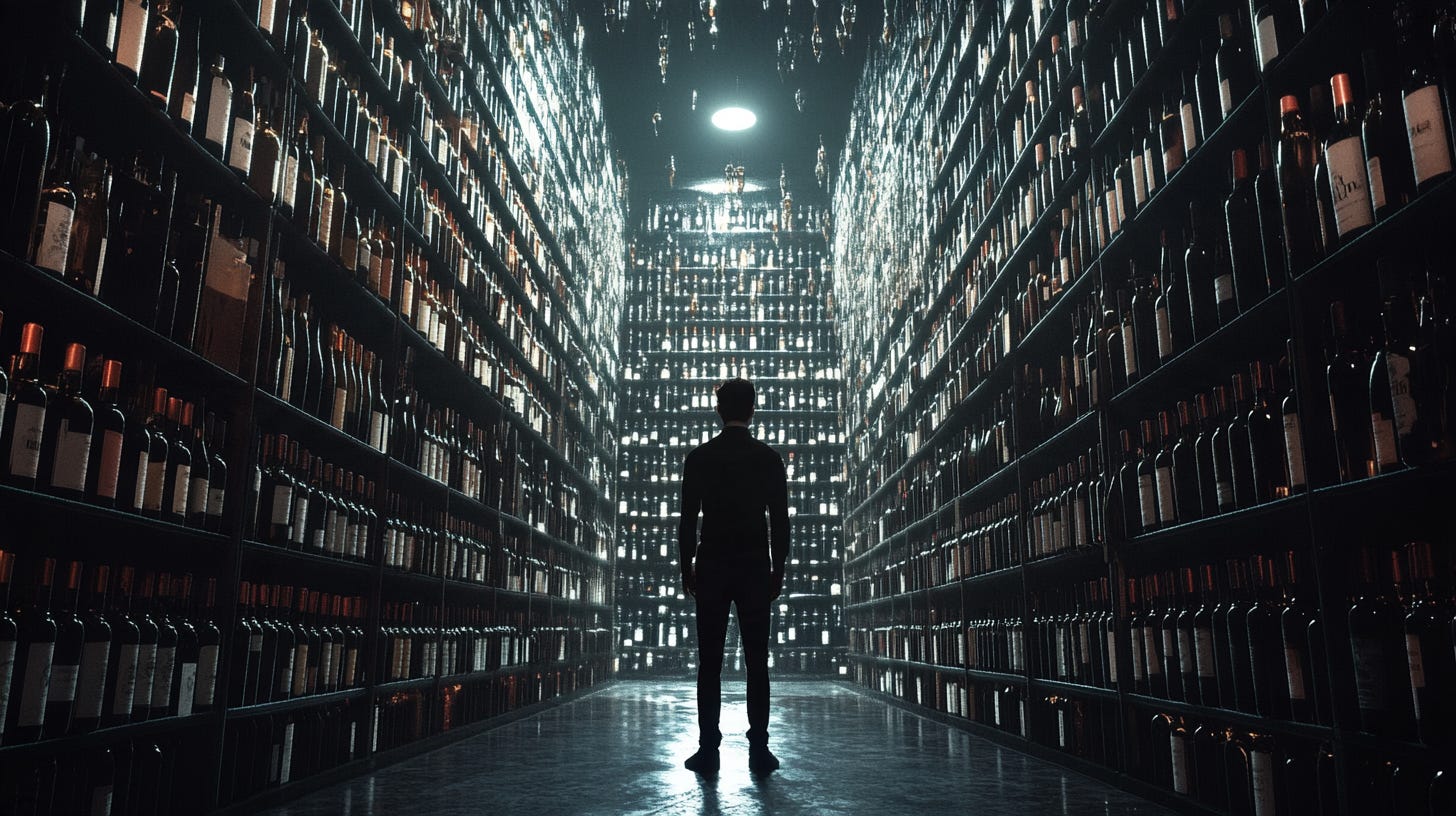
Science cannot explain everything. If it could, there would be no church-going scientists, and nobody would be arguing about quantum gravity.
But anyone who wilfully ignores psychological research - specifically, loss-aversion, choice-overload and impatience - while trying to earn a living from making and selling almost anything is fighting with one hand behind their back.
And, as I hope to show in this piece, taking the science more seriously, and looking beyond its own boundaries, may help the wine industry survive the challenges it faces.
Loss-aversion, choice-overload and impatience do not, I must stress, explain the recent fall in wine sales. People’s brains have not changed since the 1990s when sales were rising. But I’m making a narrower point that I believe is harder to dismiss. Over the decade to 2024, according to IWSR, global wine volumes fell 21%, beer by 2%, while spirits and ready-to-drink cocktails grew. The same consumers, over the same period, with the same health scares, taxes and moderation movement moved further away from wine than from other comparable beverages. Wine was the boat with the hole in it, and behavioural science offers a pretty clear indication of where to find that hole
Choice paralysis
Along with Stanley Milgram’s 1961 tests to see how many of us might become concentration camp guards, Sheena Iyengar’s and Mark Lepper’s 2000 jam study is one of the few behavioural experiments of which many people may have heard. Described simply, a display of 24 different jams attracted more browsers than one with six, but only three per cent of these people made a purchase in the first scenario, against 30% in the second. ‘Choice overload’ or ‘choice paralysis’ is a thing.
Annoyingly for those who like to quote that research, however, its findings have been hard to reproduce. A 2010 meta-analysis of 50 experiments by Benjamin Scheibehenne, Rainer Greifeneder and Peter Todd which included the authors’ own failed efforts, found an average choice-overload effect of roughly zero.
But, in their conclusions, the authors acknowledged that “It is certainly possible… that choice overload does reliably occur depending on particular moderator variables, and researchers may profitably continue to search for [them]”
Four years later, Alexander Chernev, Ulf Böckenholt and Joseph Goodman answered this challenge in a paper called Choice overload: A conceptual review and meta-analysis that pooled 99 observations covering 7,202 people, and found that overload reliably appears when one or more of four specific conditions is significantly present
a) the options are complex and hard to compare, with none being evidently dominant
b) the decision task is difficult, with many attributes per option
c) there is time pressure and accountability to others
d) the buyer cannot articulate what they want; and they would rather not spend effort trying to do so, or deciding
Under these conditions more choice produces deferral, switching, lower confidence and regret.
Lost in the snow
A few years ago, I was in a ski station in Savoie. It was my turn to buy the food and drink, so I walked to the only store, which sold almost everything any holidaying skier might need from woolly hats and ski goggles to sticking plasters, ham, cheese and wine. When it came to the latter, I found myself in front of a set of shelves full of local examples. There were bottles of Apremont, Abymes, Roussette de Savoie and Chignin-Bergeron whites from a set of unfamiliar producers. Prices ranged widely – maybe from €7-35 – and there was no way of getting any help in making a choice. The shop manager knew nothing; there was no wine guide on sale, and I had no phone signal.
Finally, I bought a couple of bottles for around €12-15, with a producer’s name that rang a vague bell (but was it the right Christian name?). On my way back to the chalet I couldn’t stop questioning whether I shouldn’t have bought a cheaper or pricier wine.
Now, bear in mind that this experience happened to a professional wine writer who had, a decade or so earlier, penned a best-selling book on French wine (that had included Savoie producers whose wines were not in that shop). How much worse would it have been for someone with less wine-involvement?
To go back to Chernev et al’s conditions, the options were, indeed complex and hard to compare; there were several attributes per option; I needed to get back to the chalet, and I wanted the others there to have decent drink (and, yes, I admit, possibly to admire my skill in having selected it).
Too much information
A supermarket that isn’t above the snow line would present a different challenge: Several hundred labels, priced within a relatively narrow band. Each has up to 10 pieces of information quite possibly in a foreign language. Knowing that a person likes Rioja or Marlborough Sauvignon doesn’t help much when there are three or four of each on the shelf. Almost inevitably, shoppers fall back on price or a score as a proxy.
Wine scores high on all four of Chernev’s conditions. Unlike beer and spirits. The claim is not that wine has too many options; it is that the options have precisely the structure the research identifies as toxic.
