


Wine is at an inflection point [a dramatic shift in direction or trend in business or life].
Specifically, large swathes of vines are being ripped out across the planet and sales of conventional wine are falling, at precisely the time when a growing number of producers are investing in making zero-alcohol versions, demand for which is growing.
Some commentators are still at the resistant “but they’re not wine” and “they’re no good” part of the learning curve

They should watch this clip from a recent BBC TV Dragon’s Den episode in which a key potential investor used almost precisely those words to describe a 0.0 called Zeno - which he then went on to describe as ‘amazing’. To be fair, the founders of the brand left the show without securing the investment they sought, but there was no denying that, as one of them said, alcohol-free wine fits the same kind of niche as decaffeinated coffee.
I’m old enough to remember French grandees straightfacedly telling me that British consumers’ enthusiasm for ‘industrial’, varietal New World wines in the 1980s was “a passing phase”. I’m ready to bet that, over the next few years, products like Zeno - and our own 0.0 Le Grand Noir - will increasingly sit alongside the full-strength wines in precisely the way that non-meat options share the space with carnivorous fare on Burger King menus.
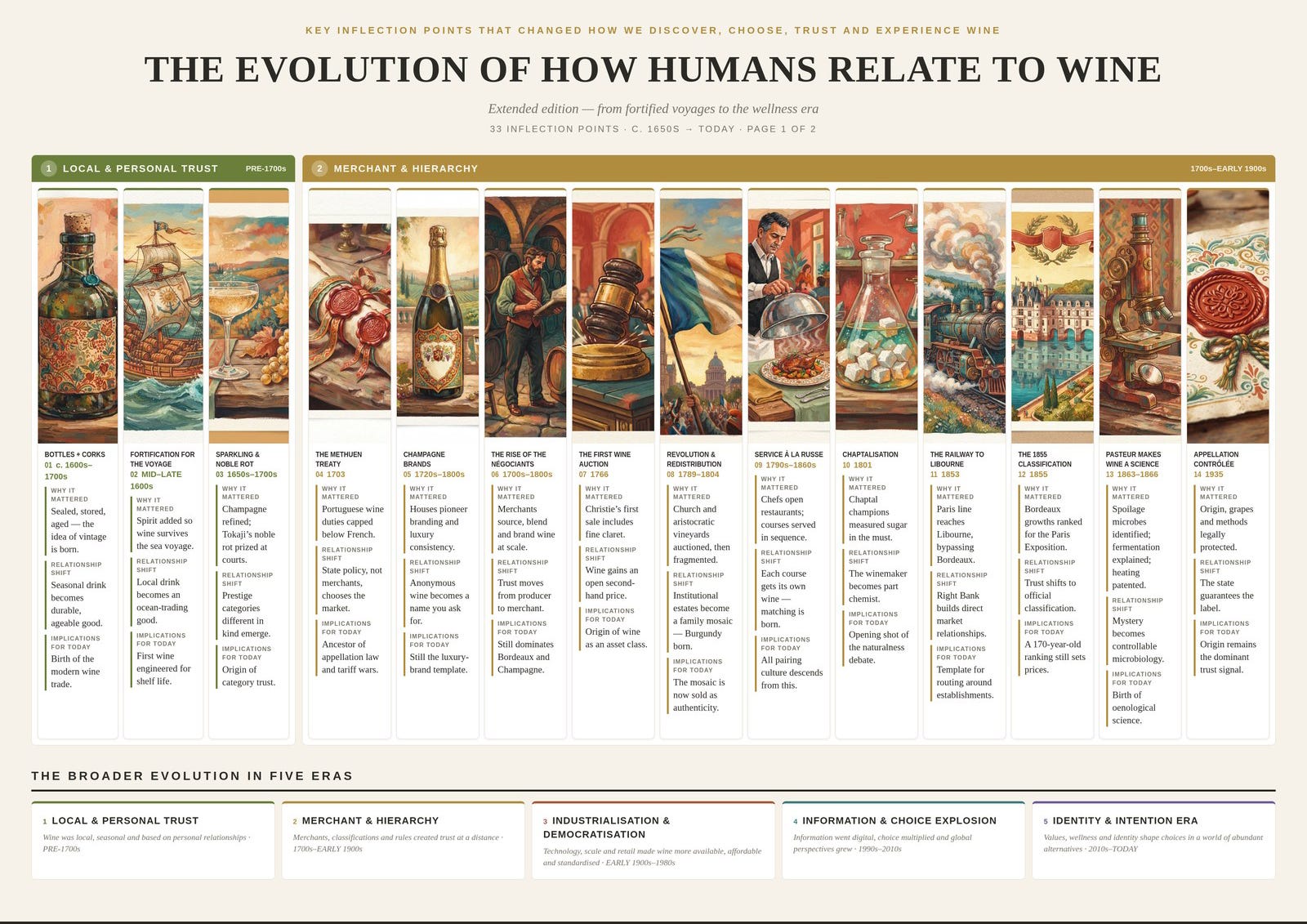
Making the infogram
The chart above began life as an attempt to answer a deceptively simple question for my forthcoming book, The Wine Crisis. I was not thinking about ‘how did wine change?’— plenty of other people have written that story — but ‘how did our relationship with it change?’. That, coupled with thoughts of the current inflection point prompted me to ask AI for help in creating an infogram. Or, what turned out to be two infograms, containing over 30 significant moments from the last four centuries or so. Presumptuously, I might suggest that they could be combined into a useful wallchart teaching aid in a wine school somewhere.
But, as I can already hear at least one opinion former sharpening his quill in preparation for laying down a list of what I’ve got wrong, I’m not saying these are 100% accurate or comprehensive. Please don’t hesitate to message me with constructive suggestions.
Also, and for the same reasons, please note that infograms come with the inevitable constraints of trying to pack a lot of information into a limited amount of space. The challenge of dealing with those constraints (and the compromises required) should explain any deficiencies you may find in the charts. They’re not intended to be treated as tablets of stone, but as thought-provokers and conversation starters.
Not destiny’s children
The overriding theme is that wine has not followed a predetermined track. Bordeaux and Champagne were not fated to be the most famous wine regions in France, or indeed the world.
If the cards had been dealt differently, who can say how the wine map would look today? To go back further in time than I chose to here, we can wonder what might have happened if the drainage the Romans installed in the Maremma had survived, or if the English had never owned Aquitaine or drained the Médoc. Might the western part of Tuscany have taken the throne occupied in our world by the land to the north of Bordeaux? And might that corner of France have remained a mosquito-infested swamp until the 20th century?
The 33 points in these two charts all reflect moments when the relationships between humans and wine changed, if only slightly. When a French villager for the first time became able to taste wine from another part of France; when a lawyer in Paris first considered laying a wine down for his son to enjoy; when a Burgundian vigneron discovered that adding sugar to a vat of barely-ripe Pinot Noir could miraculously help to make it saleable.
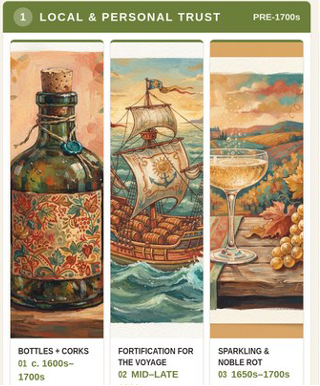
Part One: Local and Personal Trust (c. 1600s–1700s)
After the era when the Romans shipped wine around their empire in boats with huge, ceramic, wine-filled dolia, and apart from brief periods such as when vast numbers of casks of French wine were shipped to England in 1152, for the wedding of the future King Henry II to Eleanor of Aquitaine, through much of human history, wine had little reason to travel. Which was just as well, because it didn’t often do it very well. Most spoiled within a few months of the harvest. It was sold, bought and consumed close to where the grapes were grown. The exceptions to this rule were wines worth transporting to the highest in the land in small volumes that have received far too much attention.
1. Bottles + Corks — c. 1600s–1700s
The wine industry - and wine drinkers - owe much to the English creators of cheap glass bottles and cork stoppers. Suddenly, small volumes of wine could be sealed reliably and - miracle of miracles - allowed to improve over time. A tiny number of noble/wealthy Romans had understood that this was possible - in amphora - but the concept had been largely forgotten. Along with other pieces of ancient knowledge.
Storing wine in bottles also allowed 17th and 18th century wine drinkers to compare the difference between vintages.
Note that, while wine was transported and sold in Britain as soon as the glassware wa available, the French had to wait until 25 May 1728, when Louis XV’s Conseil d’État authorised the transport and commerce of Champagne wine in bottles, in baskets of 50 or 100. Burgundy was authorised to transport wine in bottles 22 years later. Bordeaux appears to have escaped the earlier sanctions. Bottling was already practised in the early eighteenth century, but most Bordeaux continued to be exported in barrel and bottled by merchants—especially in England.
The final paragraph of Bottles + Corks was added shortly after initial publication.
2. Fortification for the Voyage — mid–late 1600s
Most wine wasn’t shipped in bottle, however. It was transported in barrels, in the holds of ships where high temperatures led to it turning into vinegar. Adding brandy to the beverages we know as Madeira, port, sherry and Marsala helped make them marketable at the end of the voyage. No one created these styles because they wanted a new style of beverage; they were solving a commercial problem. But this did not prevent them from becoming essential parts of what everyone knows as ‘wine’ today.
3. Sparkling & Noble Rot Emerge — 1650s–1700s
The Romans also understood how to make sweet wine - from dried grapes - but the discovery of what noble rot could contribute had to wait until the 16th century in Hungary. The work required to produce Tokaji and its unique flavour helped it to become a luxury in the eyes of the Polish nobility; the Habsburg and Russian imperial courts; and the court of Louis XIV, where it was supposedly called ‘king of wine; wine of kings’. Tokaji’s success laid the foundations for late-harvest wines elsewhere, but none of this history and their deliciousness, has saved great sweet wines from falling out of fashion. Today, with a few exceptions, they arguably represent the world’s worst vinous return on investment for the producer, and the best bargain for the consumer.
Champagne, it is now increasingly agreed, was probably invented in England, but who cares? It was popularised by an abbot in Champagne who later gave his name to one of the best-known prestige cuvées. Unlike late-harvest wines, as a sector, it has been well managed by clever brand-owners who have adapted their product to suit the market.
In both cases, genuinely new, man-made styles had been created, and a template for luxury wine laid down.
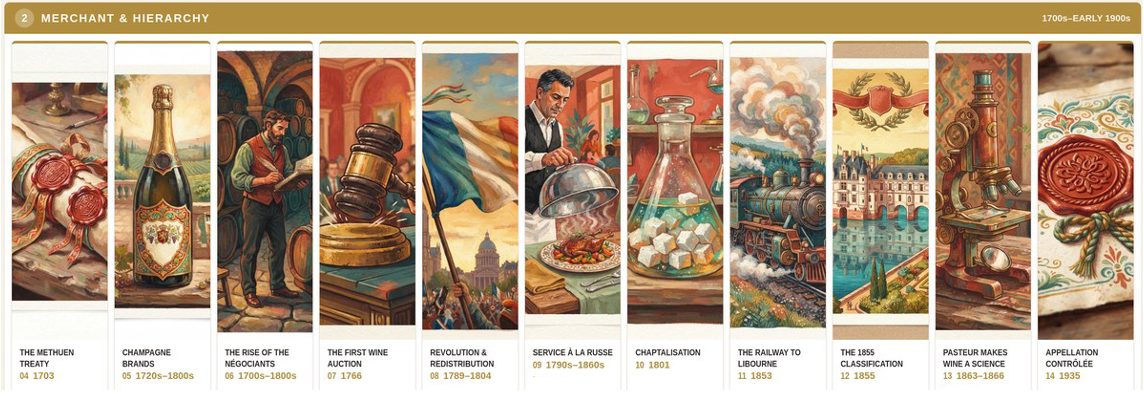
Merchant & Hierarchy - 1600s - 1900s
Well-heeled Roman wine drinkers would have known about men in the wine business with - in order of the scale of their operations - titles of negotians vinarius (trader), negotiator vinarius (merchant) and mercator vinarius (importer/exporter). Wine trading continued throughout medieval Europe, principally through the Italian republics, the Rhine and Hanseatic cities, Bordeaux and the English ports. But in the 17th and 18th centuries, businesses in Amsterdam, Rotterdam, London and Bordeaux developed a more recognisably modern wine trade. For the first time, there was a network of merchant houses with the cash necessary to finance production, and the skills required to select, blend and mature wines, and to deliver them to customers in distant markets.
4. The Methuen Treaty — 1703
Canadians who, until recently, enjoyed drinking Californian wine, have switched their allegiance to other countries - not because they preferred the taste, but because of tariffs. In Britain, it was French wine that was removed from the tables in 1703, after a new duty regime made Portuguese more financially attractive. The port trade owed its birth and adoption to the relationship between governments. A common story over the centuries ever since.
5. Champagne Brands Arrive — 1720s–1800s
Ruinart in 1729, Moët in 1743, the widow Clicquot and others, collectively invented modern branded wine. Not just through promoting their names - Pontac had done that with Haut Brion in the previous century - but more importantly, through blending for consistency. With branding came marketing budgets to cover the costs of packaging and posters - and, in more recent times, sponsorship.
Three centuries later, Champagne still plays by different rules to every other wine. Talking terroir on the one hand, while unashamedly behaving like a luxury good on the other. And enjoying margins that are the envy of everyone else.
6. The Rise of the Négociants — 1700s–1800s
Alongside the rise of the merchants we’ve already mentioned, this period also saw the evolution of negociants within wine regions. These businesses were a reaction to greater distribution across longer distances and customers’ demand for larger volumes of the same product. Crucially, unlike the vigneron who either relied on the landowner whose vines he farmed or lived from hand to mouth by selling what they produced, the negociant-éleveur had reserves of cash that enabled him to
advance money or credit to growers;
help them carry the costs of poor vintages;
buy grapes, must or unfinished wine;
assemble wines from numerous properties;
mature, clarify and stabilise the wine;
provide barrels, and later bottles;
create a consistent commercial style;
store several vintages;
bottle and label the wine;
sell it through national or export networks.
He was a combination of merchant, blender, winemaker and banker. Generally, unlike the growers who were stuck in their villages, these businesses were based in commercial centres such as:
Bordeaux and Libourne;
Beaune and Mâcon
Reims and Épernay;
Nantes;
Lyon;
Bercy in Paris.
Like merchants dealing in silks and other goods, they were able to work with importers based in London, Amsterdam, Brussels, Hamburg or Paris. They often spoke the languages, understood duties and shipping.
Crucially, their name also served as a guarantee to the importer and sometimes beyond. So British, Belgian and Dutch importers bought barrels of Bordeaux Chateaux X from negociant Y who they knew had looked after the wine since collecting it from the estate. Subsequently, the same negociant might be similarly trusted, and for similar reasons, by customers buying in bottle.
In Burgundy, while a small number of estates began to develop international reputations it was the negociants who represented the region, just as their counterparts did in Champagne. In the 1980s, when I took Jancis robinson’s predecessor at the Financial Times, an already-aged Edmund Penning-Rowsell, to the Domaine de la Pousse d’Or in Volnay, it was the first Burgundian estate he had ever visited. Every report he had ever written prior to that had exclusively quoted his favourite negociants.
Within France, the negociants were the necessary link between small producers and supermarkets and bigger specialist retailers like Nicolas who need to buy in volumes. But they were also a crucial partners to the cooperatives that still produce half of France’s wine - see Part 2.
7. The First Wine Auction — 1766
The first sale by James Christie included fine claret and, for the first time, gave wine something no food had really had before: a price in a secondary market that was visible to all. Wine ceased to be just a drink; it became an asset with a track record, a market and, eventually and inevitably, an index. Would the concept of ‘fine wine’ have developed without auctions? Would markets for top wines in the US and Asia have grown without their introduction into New York and Hong Kong? Every wine investment fund, every headline stating that “Bordeaux outperformed gold” can be traced back to that December afternoon in London.
8. Revolution & Redistribution — 1789–1804
The French wine landscape we know today owes much to the years following the fall of the Bastille, but not necessarily in ways that are often imagined.
There was no simple wholesale transfer of land from the aristocracy and the Church to the peasants. Vineyards were confiscated and often sold to people with money. Vineyards became tradeable in their own right.
The introduction of equal inheritance from 1793 (codified in 1804) contributed to this, as heirs sold land - or bought it with inherited money. Repeated division and fragmentation, and the consequent splitting of the ownership of prime vineyards was not inevitable. Its incidence depended on the size of the plot/s and their importance to the family. In regions like Burgundy, it was common (good news for negociants), while in Bordeaux where the estates were bigger and treated more like businesses, chateaux often managed to maintain their pre-Revolutionary shape and size.
So, the Revolution led to fragmentation of landholdings, but also to unification (through purchase and/or marriage) and the growth in the role of negociants. And, of course, having multiple owners of some prime plots may have helped to build their reputation way beyond anything a monastery monopole might have achieved. (Though Germany has examples that suggest otherwise).
9. Service à la Russe — 1790s–1860s
The role of the Revolution in driving displaced chefs to open restaurants is probably overstated, but the Russian ambassador’s habit of presenting courses in sequence, in the Russian style rather than the old ‘French’ architectural assembly of dishes that were all served simultaneously, spread through Paris very quickly in the late 1800s. Suddenly, each course needed its own glass, and wine. Food-and-wine matching wasn’t an ancient tradition or a discovered by sommeliers; it was created by table logistics. And somehow became an essential part of vinous lore.
10. Chaptalisation — 1801
Grape ripeness has been a concern since at least 1210 when Duke Eudes III of Burgundy gave the town of Beaune the right to proclaim the ‘ban’ - the day the harvest could begin. This was almost certainly predated by similar Frankish/feudal droits de ban.
Five centuries later, the Revolution abolished the feudal ban, although some communes maintained the tradition which also had the advantage of making the harvest a communal activity. It was not reintroduced as part of French national wine law until August 13, 1940 (codified 1946) - after the arrival of appellation contrôlée,
Over the intervening 150 or so years after the technique of enriching must with sugar was publicised by Jean-Antoine Chaptal in 1801, growers used the technique to help get the best wine possible out of cold, rainy years.
For the first time farmers had, at least partially, become chemists, and the grounds had been laid for the natural vs industrial wine debate that rages on today.
11. The Railway to Libourne — 1853
Until the Paris line reached Libourne, Right Bank producers wanting to sell their wine relied on the courtiers - brokers - in the city of Bordeaux on the other side of the river. Overnight, St-Émilion and Pomerol were able to build their own relationships with buyers in the capital and port cities further north. A railway junction had changed their fortunes - in much the way that the arrival of container ships, a century later, did for wine regions on the other side of the world. (see Part 2).
12. The 1855 Classification — 1855
The famous 1855 hierarchy was not the first ranking of its kind; brokers had been maintaining this kind of model for some years. But this was the one that was supposedly knocked up in an afternoon, in response to a request from Napoleon III who wanted it for the Paris Exposition. That ‘official’ classification became a trust signal that may look a bit tattered today after 170 years, but it embedded the industry’s most conservative idea: that whatever the weather and the winemaking this year, quality can be established in a list. This was the model Robert Parker sought to challenge with the scores in his Wine Advocate, and the one that the current owners of that newsletter seem to be still treating with reverence in their first Michelin Guide to Wine.
13. Pasteur Makes Wine a Science — 1863–1866
Napoleon III asked Pasteur why wine went ‘off’; Pasteur answered with microbiology: explanations of fermentation and spoilage and the role that temperature could have in both processes. Winemaking ceased to be a natural mystery; it became ‘controllable’. Wineries with laboratories, or a relationship with an oenologist could produce consistently good wine. The concept of ‘natural wine’ could not have existed without Pasteur; nobody would know what they were rebelling against.
14. Appellation Contrôlée — 1935
There is nothing new about wine fakery. In the 19th century, especially during the phylloxera shortage of the 1870s–1890s, French production fell from about 84 million hectolitres in 1875 to 23 million in 1889. Demand was high; supplies were limited, so there were plenty of opportunities for the production of wine-like liquid.
There were many stories of wine being diluted and then ‘restored’ with cheap alcohol by Paris merchants, and of the miraculous transformation into wine of piquette, made by using water and sugar to referment grape skins from which real wine had already been produced,
‘Wine’ was produced from dried grapes imported from Greece, Turkey and the eastern Mediterranean, and from concoctions involving water, beet sugar, yeast, tartaric acid, industrial alcohol and colouring and flavouring.
Cheap, basic wine was ‘improved’, or ‘doctored’ by the addition of elderberries, cochineal, beetroot, logwood or bois de Campêche, coal-tar and aniline dyes and, most famously, fuchsine, a vivid magenta industrial dye that sometimes contained arsenic. In 1876, 350 barrels of fuchsine-coloured wine were seized on arrival in Paris, and the Journal officiel subsequently discussed the health risks of repeated consumption.
Chemical toolkits were used to give wine acidity, body and apparent maturity. The ‘tools’ included tartaric acid, glycerol, sugar, tannin, gall nuts or chestnut extracts , salt or mineral additions to alter flavour, caramel to deepen colour and suggest age, ethers and aromatic essences to imitate bouquet and, of course, alcohol to replace strength lost through dilution. Some fakers went further. French archival records from 1876–94 include investigations of wines containing sulphuric or nitric acid.
Plâtrage - adding gypsum (calcium sulphate) to crushed grapes or must - improved colour stability, reduced some forms of instability and could make weak wine appear firmer and more acidic. The practice was well established in parts of southern France and not automatically regarded as fraud, but excessive use to conceal questionable concoctions led to it becoming a major public-health and regulatory concern.
Inevitably, during the phylloxera crisis France imported large quantities of wine, especially from Algeria, then legally part of France, Spain and Italy and passing it off as being from a famous French region. Often, the foreign wine was blended with the real thing, to make the latter go further, or compensate for its deficiencies. Alternatively, strong, dark wines from the Rhône, Languedoc or Roussillon could be shipped north or west to be transformed into, or help to boost, ‘Burgundy’ or ‘Bordeaux’. Where necessary, colour and/or alcohol was added to the final blend.
The Griffe Law of 14 August 1889 sought to tidy this all up by defining wine as the product of the fermentation of fresh grapes, but it did not address provenance. This process began in 1919 with the judicial protection of appellations of origin, and in 1935 with the creation of the modern AOC system.
Officially recognised regions had been created long before, in Hungary and Portugal, but the French model was the one the rest of the world latched onto.
In the 90 years since its invention, AOC has spawned AOP, PDO, DO, DOC, DOCG and lots of variations, but it has also moved a long way from its original role of protecting consumers and producers against falsification. Today’s appellations are far too often would-be brands, without the expertise or budgets to play that role effectively. Winemakers in too many countries and regions imagine that drawing a line on a map and getting an official stamp from the regional and/or national government will solve their problems. Too few have noticed the growth in the sales of Vin de France - the young designation that completely contradicts the AOC philosophy.
Where this leaves us — and what comes next
Each of the 14 inflections listed here added a layer of trust between the drinker and the wine, and made wine safer to buy, easier to sell and less directly linked to the person who grew it.
The next installment covers the inflection points from the 1850s to today — the era that industrialised, democratised and globalised wine, before more recently beginning to ask whether humans actually wanted it. It includes the moment when the wine industry lost its social licence, the bottle that defined a British generation, and the way a single critic’s palate set the price of an entire vintage.
If you’d like the full chart as a print-ready A4 wallchart — both parts, 33 inflection points — it’s here

Part 2 lands on Wine Thinking on Monday.
And if you enjoy this kind of long-read, subscribe to Wine Thinking — it’s free. Paid subscribers get the deep-dives, like Shortage of Cash about the biggest financial challenges facing wine businesses, After the Fires on the 2025 smoke-taint vintage, and the interactive Modelling the Road to 2050, the consumption model behind my book, The Wine Crisis.