


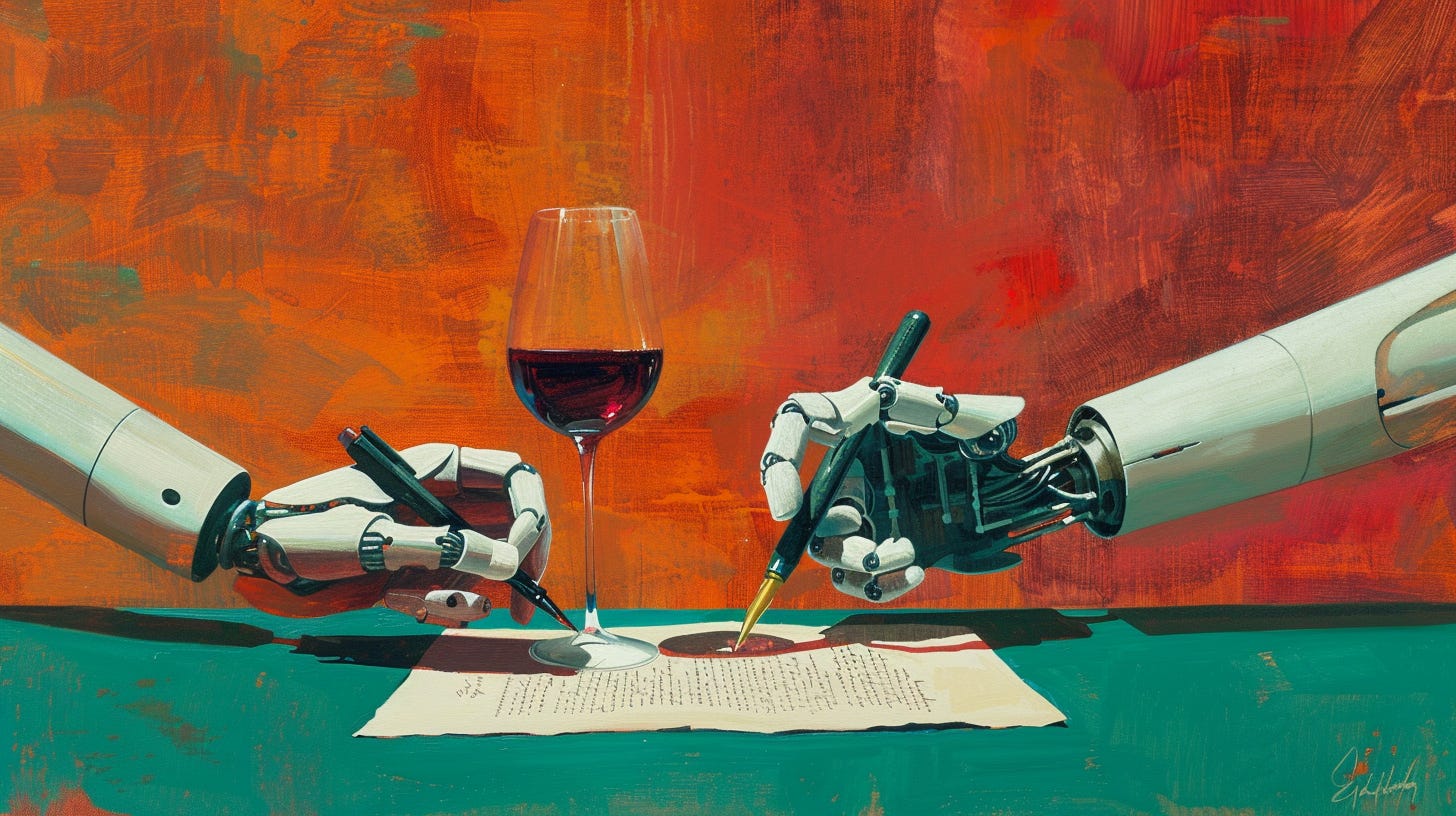
At a time when unusually well-informed people are publicly saying that AI could kill us all, discussions of its use by wine writers might seem to be a little… quaint.
But we’re also in an era when a president of the USA, famous for his loose relationship with the truth, is barring genuine journalists from the White House because they report ‘fake news’ he doesn’t like. So, knowing what is and isn’t real matters more than ever. And, for those who care about wine, that includes the words that are written about it.
I’ve held off publishing anything about the Fikayo Ifaturoti / 67 Pall Mall Wine Communicator Awards story because, while discussing it in depth with others, I wasn’t sure that I had anything fresh to say.
Note: since first posting this piece, the French media has reported that Thélyson Orélien has been accused of using AI to write his best-selling, critically-acclaimed novel C’était ça ou Mourir.
I’m not 100% certain that everything that follows in this piece is going to prove otherwise, but here are a few thoughts about AI - or LLMs (Large Language Models) - generally, and its relationship with the fruits of the vine.
1) Computers we can communicate with are less novel than we suppose.
At the 1972 International Conference on Computer Communications, ELIZA, a programme created between 1964 and 1966 at MIT by German-American computer scientist Joseph Weizenbaum, conversed with Parry, whose ‘parent’ in 1972 was Kenneth Colby, a psychiatrist at Stanford University. The medium used was ARPANET (the precursor to the internet.
Parry was good enough to pass the Turing Test 48% of the time when ‘talking’ to psychiatrists.
Next, in 1995, came A.L.I.C.E. (Artificial Linguistic Internet Computer Entity), which won the Loebner Prize, awarded to the “most human” chatbot, in 2000, 2001, and 2004 and was credited by Spike Jonze as the inspiration for his Oscar-winning film Her, about a man who falls in love with an AI.
In 2001, ActiveBuddy was launched as a source of information about weather, stocks, and news. But it also appeared on AOL Instant Messenger contact lists as SmarterChild. As PocketSouls.com reports, “ActiveBuddy discovered that 97% of their users were simply chatting with SmarterChild for fun — a category they called ‘inane chat.’ Kids would talk to it for hours. They’d test its limits, try to make it angry, share their problems. SmarterChild had personality: it was snarky, funny, and — when users were abusive — it would get offended and temporarily stop responding.”
Radiohead also used ActiveBuddy tech to create a chatbot as part of the promotion for their Amnesiac album.
In 2008, Cleverbot arrived with the concept that it would learn entirely from human conversations. In a Turing test, it was scored at 59.3% human, just 4% behind real humans.
Then Apple launched Siri in 2011, and Amazon followed its lead with Alexa three years later.
In recent years, alongside all these clear precursors to ChatGPT et al., most of us have been happily using Google Maps, which mysteriously gets us to distant destinations within minutes of an estimated arrival time. We’ve watched movies and TV programmes recommended by Netflix and listened to ‘our’ Spotify playlists through noise-cancelling headphones while reading machine-translated, spam-filtered emails and OCR-scanned PDFs.
In other words, we’ve all been living with AI for ages, and have only just begun to talk about it.
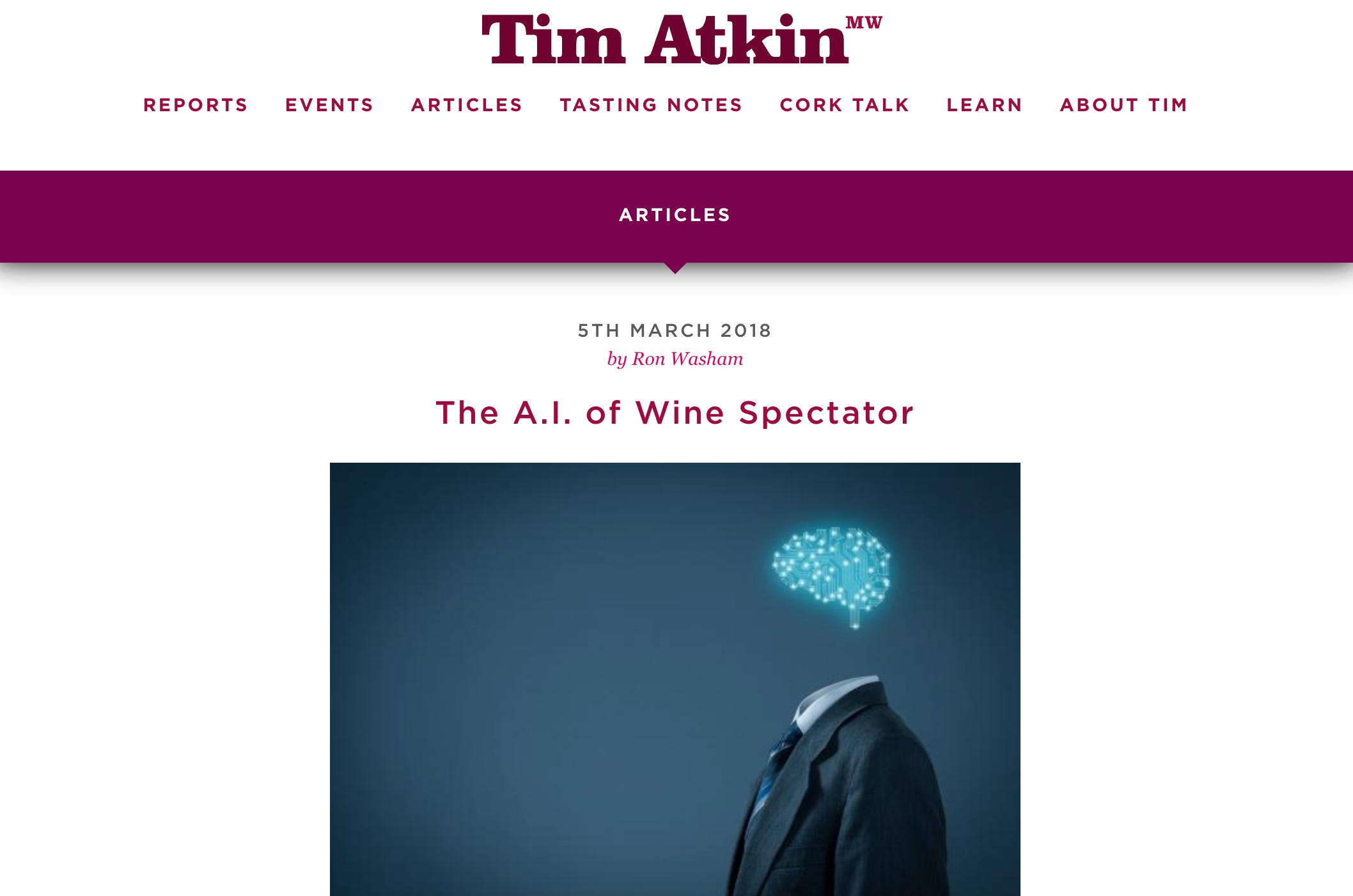
(Though, to be fair, Ron Washam did write an excellent satirical piece about AI and wine, eight years ago for TimAtkin.com.
2) There’s a lot more LLM around than we realise.
Reuters famously uses it and only promises to share that information when generative AI is the “primary or sole” means of production. A report substantially drafted, translated, condensed or reworked with AI—but still directed and approved by a journalist—could fall outside those rules. AP Reuters’ rival is stricter, allowing journalists to use it to
automate routine reports derived from reliable, structured data
translate or organise material
transcribe audio and video
generate possible headlines, summaries or interview questions
identify patterns that might lead to a story
I can really identify with that last one. You ask ChatGPT or Claude a few questions while researching a piece and you end up going down rabbit holes and quite possibly taking a different direction from the one you intended. But, the same is true of Google or any good encyclopedia.
Anyway, I suspect that other publications, especially trade journals that are produced quickly and with limited budgets, will take a far more relaxed approach than AP, and possibly Reuters. And, given the casual way in which their reports of product launches and changes in regulations are often read, this might be all too understandable.
3) AI is, of course, rapidly getting better at what it does.
Today, we can recognise ‘tells’ in pieces of text (“it isn’t this; it’s that”) and we can run them through platforms like Pangram that can supposedly identify AI authorship with over 90% efficiency - except the platforms don’t always agree. But, in any case, how long will this be possible? In a Substack on the subject, Ellen Doggett quotes an AI professional as saying that “platforms like ChatGPT, Claude and Gemini are constantly being trained on huge amounts of data, and with a bit of prompt refinement, it’s easy for people to write convincingly with AI. Detectors simply aren’t developing at the same rate as the AI they’re meant to be analysing.”
Robots that used to struggle to climb stairs can now break dance. ‘Tilly Norwood’, the AI actor who suddenly began to speak Chinese in the middle of an interview with Piers Morgan will have successors that will be more fluent than plenty of humans. Like people involved in competitive sports, educators and writing competition judges are going to have an increasingly tough time spotting what’s real.
4) There’s going to be a lot more.
Businesses and individuals with a need to market their services and goods, and limited expertise and cash, will take advantage of a growing range of AI options, just as they have of digital translation and transcription. Website text, leaflets and press releases will all be churned out by bots and, to be honest, they’ll be no worse, and often almost certainly better than the amateur(ish) efforts of the past. But this will extend into advertorial copy and the pages of publications, newsletters and substacks. Where it is already to be found.

5) Robots - AI on legs or wheels - will increasingly become part of the landscape.
Driverless taxis have already arrived and will soon be everywhere; how many of us will choose to wait 40 minutes for a car with a human rather than one right now without one ? How many owners of autonomous vacuum cleaners and lawnmowers will shell out large sums to buy robots that can tidy homes, fold laundry, load and unload dishwashers and washing machines and are already available to order? How much caregiving will involve robots? China has over 16 million people with dementia and, by 2035, will have 400 million over the age of 60. It already has more than 150 companies making humanoid-robots. By 2040, Japan, with an even bigger demographic problem, aims to have 10 million AI-powered robots across all sectors.
6) Which brings me back to wine.
Like the caregiving professions, winemaking is suffering from labour shortages and, within a decade, AI, and AI-powered, robots are going to be deployed to address that at every stage.
They will perform most routine vineyard work, including the tricky task of pruning. Drones and sensors will identify disease, water and nutrition problems, vine by vine. Robots will treat the affected ones. Harvest timing and parcel allocation will be based on AI use of climate data; picking will be done by autonomous machines; grapes will be sorted digitally; AI will control fermentation.

Obviously, there will be human beings around to supervise the system and deal with problems and exceptions (including the occasional, hard-to-prune vine), and - before anyone chips in to suggest otherwise - none of this will apply to top flight Burgundy estates or Bordeaux Crus Classés. But I can see a version of it applying to the kinds of wines most people actually drink. A glimpse of this future is already available at Xige Estate (西鸽酒庄), at Qingtongxia in Ningxia, China, which is set up to enable a small cellar team to remotely interact with computers that control much of the grape reception, fermentation, wine movement and packaging.
If low-intervention winemaking is popular today, it could be having a real moment in 15 years time.
7) We’re ambivalent about AI.
Some people took to Reddit to say how much they’d have preferred the Get Back movie to be made up of the grainy, warts-and-all footage and poor-sound material in the Beatles archive. Far fewer, I’ll bet, than the number who happily queued up to buy tickets to the glossy version Peter Jackson spent millions cleaning up.
Over recent months, we seem to have reached peak anti-AI, and the words ‘AI slop’ are used to dismiss any image that hasn’t been painstakingly produced by a human being. But what would the people using that term make of artworks by a long list of respected modern artists, ranging from Warhol and Duchamp to Damien Hirst, Jean Tinguely, Gustav Metzger and Jeff Koons, none of whom behaved like the traditional wielder of charcoal and paintbrushes? And what of Harold Cohen’s AARON, which involved a computer programme devised in the late 1960s to compose drawings and colour images autonomously, or Vera Molnar, who was using computers to create art in 1981? And what about Brian Eno’s ‘generative’ music, Aphex Twin or, indeed the Beatles Now and Then?
I will freely admit to having liked many images and video clips that I’m sure were created using AI. Like these two that literally would never have existed without it.


I was also fascinated by this article about White House corruption which Pangram says was 100% written by AI. Would it necessarily have been ‘better’, and/or would I have found it more interesting if the writer had penned every single one of the 7,600 words, and plotted all the graphs herself?
On the other hand, would the world be a ‘better’ place if the piece had never been written? Which, given the time it would have taken to produce it manually and the low likelihood of a well-paid commission from a publisher, is all too likely.
From my experience experimenting with AI, I know that producing that kind of article involves far more effort than simply coming up with a prompt.
But, if I had spent days writing a piece of that length and depth in my own words (as I do), with or without the use of AI in doing the research, how would I have felt to see my work beaten in a competition by a totally computerised entry?
There are no easy answers
The only solution that I can see is for writers and publishers to attach a clear statement to everything they create:
No AI used
AI used for grammar and fact-checking.
AI used for research
Partly or wholly written by AI
Will that solve all the issues we’ve seen over the last week over the 67 Pall Mall Wine Comunication Awards?
That depends on the integrity of the people involved. What I can say is that, from this piece onwards, is that it’s a model I plan to follow. And, yes, I admit to having resorted to AI to research the early use of computers by artists, and to having run the piece through an AI editor (which picked up a few typos and a missing link) but, as usual, the words and opinions are all my own. So if you disagree with any or all of it, you are doing so with a human, not some lines of code.
DECLARATION FOR THIS PIECE
AI used for image
AI used for grammar and fact-checking.
AI used for research
Well, i just read acclaimed wining wine ‚writing‘ article and i am completely stunned. It bears the hallmarks of ai writing. That the jury defends their decision of actually not being able to discern genuine writing from ai generated slop is mind blowing. I know where youre coming from - using ai to
iterate over parts of your text. I use this at times just to help me formulate my thoughts and what i want to say - however all these obviously ai structured sentences. I am speechless. Seriously.
I believe we need to start accepting that AI has now become part of our lives as an important, everyday tool, and that it will not be easy to do without it.
For example, I am writing this reply in Italian, and AI will translate it into English for me. I can then ask it to adjust the tone or polish the grammar. All of this is extremely useful as long as I am still the one giving meaning to my thoughts, and I use AI only as a tool to make those thoughts clearer, more polished, and easier for most of you to understand.
The problem begins when AI is asked to generate an article or a response entirely on its own, without being given clear and precise input. In that case, the result will usually be mediocre and generic, much like many of the articles we already see online.
Is it possible that even the kind of “light” use I have just described will, in the long run, weaken or “atrophy” our ability to write? I am sure it will, just as the invention of writing affected the human ability to memorize ancient poems and stories that had previously been passed down orally.
The real problem, however, will arise when AI takes control to a much greater extent: when the people replying to a thread are no longer two human beings using AI to help with writing, translation, or grammar, but two AIs talking to each other through two human beings who simply copy the answers and paste them into the thread.
As absurd as that may sound, I believe this could be the real danger. And it always seems to lead in the same direction: control and uniformity.