


This is a free Wine Thinking article. Free subscribers get the diagnosis; paid subscribers get the solutions. Wine Thinking: #17 on Substack's New Bestsellers, 3,600 subscribers.
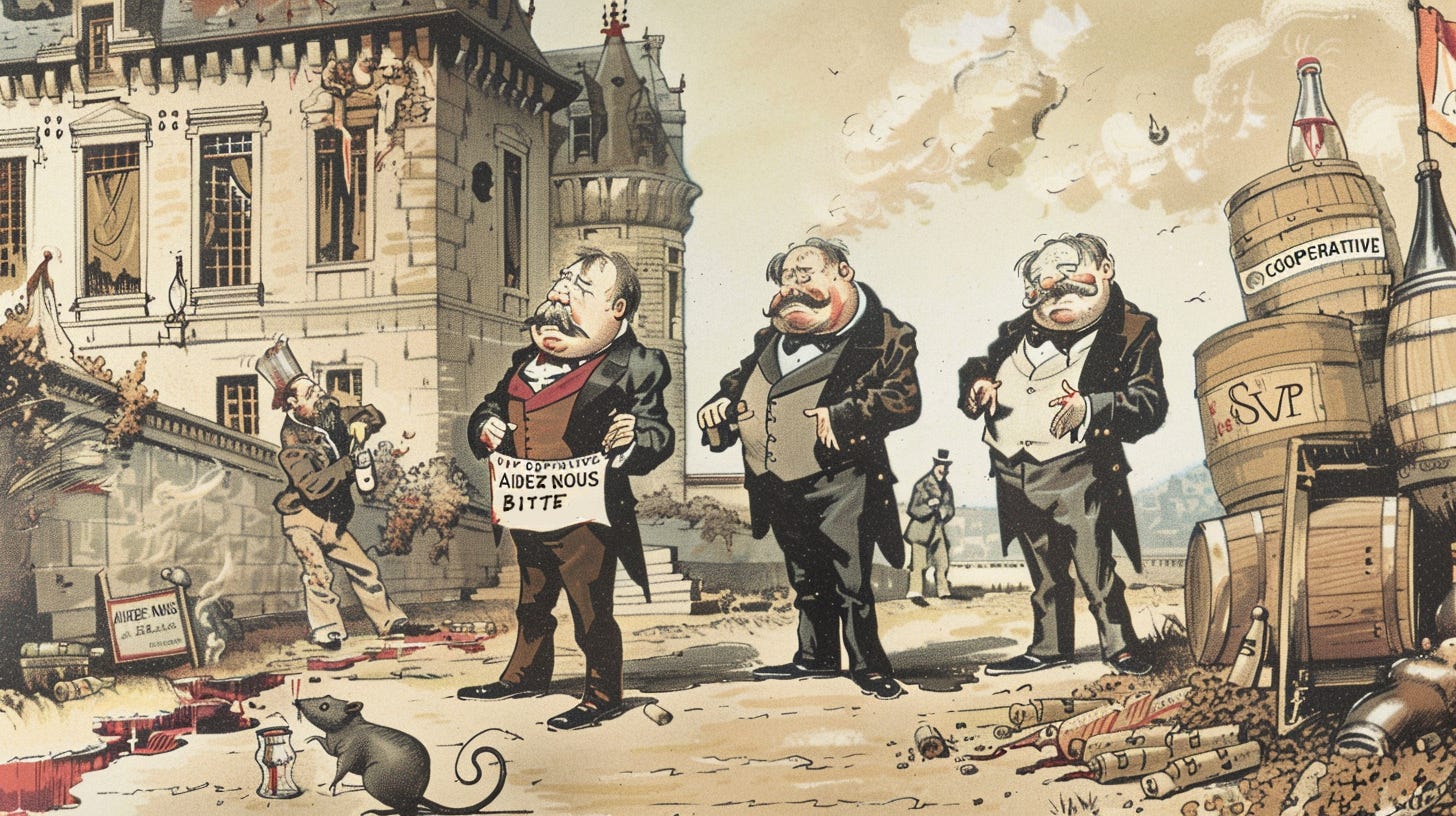
Approximately 1,600 cooperatives, collectively-owned by an estimated half a million growers with an average landholding of around three hectares, produce one bottle in four of the wine on this planet.
These are businesses that go almost entirely unmentioned in wine media which is ready to devote large amounts of attention and space to ‘fine wines’ (which are bought and sold on the secondary market), ‘luxury wines’ (which sell for over $50 a bottle), and ‘natural wines’. If you remove possible duplication between these categories, you get to respective market shares of 0.2%, 1.5% and a maximum of 0.7%. Less than 2.5%, between them.
In the US, critics casually talk pejoratively about ‘Big Wine’ - corporations like Gallo, Constellation and the Wine Group - as though it were comparable to ‘Big Pharma’, and responsible for many of the wine industry’s problems. These three giants are admittedly significant in the United States, but globally, between them, they produce around 134 million cases, or 12 million hectolitres. Five per cent.
Calling this trio ‘Big Wine’ while ignoring the European cooperatives reminds me of the moment in the 1986 comedy movie, Crocodile Dundee, in which Paul Hogan playing the eponymous Australian bushman is confronted by a flick-knife-wielding mugger in New York. That’s not a knife, Hogan says with a smile as he pulls out the serious blade he relies on in the outback. That’s a knife.
America’s big knife
To be fair, collectively, Europe’s wine cooperatives have very little in common with a resourceful individual who can wrestle with crocodiles. Until relatively recently, that description might have been more aptly associated with the US, which has created a wine market that represents 13% of the volume of the global wine trade and 16% of its value. It has also operated in a premium bubble, where over 15% of the wine-dollars have been spent on luxury wine, and 2-4% each on fine and natural. The volume shares are a lot lower - probably around 6% - but still between two and three times the global figure.
Even so, to look at the wine crisis without factoring in the state of Europe’s wine cooperatives, is like discussing global automobile production without considering China’s part in it. (Around 37%, in case you were wondering; roughly as much as Europe, the US and Japan combined).
So, here’s a quick roundup of what has been happening to Europe’s very own Big Wine.
What’s happening
According to a French Ministry of Agriculture/CGAAER report published in March 2026, La Coopération Agricole, the union that represents the sector, estimated around 100 French wine cooperatives were in difficulty before the 2025 harvest. This number reportedly rose further after the harvest. The worst-affected areas were Occitanie, Rhône, Provence and Bordeaux. In the Gard region, there was discussion of whether eight cooperative production sites out of 80 might need to close, and in another - unnamed - French département, investigators reported that 75% of cooperatives had difficulty servicing their debts, either through late payments or missed instalments.
Overall, default rates rose 23.4% between 2023 and 2024 and, by spring 2024, many cooperatives had cut growers’ advance payments by 50% or more.
Also in that same report, there was coverage of the fact that five cooperatives in Nouvelle-Aquitaine - including Buzet, Univitis and Saint-Estèphe - had entered collective proceedings or judicial restructuring. The cooperatives in the region apparently carried €212.7m of debt while, the Crédit Agricole bank estimated that, in 2025, French wine cooperatives nationally were looking at financial exposure in excess of €250m.
Another report - in Vitisphere, in October 2024, suggested that one in five French cooperatives were in trouble: 50% in the Rhône, 40% in Bordeaux and 37% in the South. 100, the magazine said, were facing financial situations that could lead to their collapse.
When they hit the buffers, some cooperatives manage to reschedule their debts (increasing the Credit Agricole exposure); some close. Often, they are absorbed into larger coops nearby but, increasingly, management and distribution deals are being signed with privately-owned businesses.
A few key examples
France
Vignerons de Saint-Sardos, Tarn-et-Garonne. A 15-year recovery plan was approved in Dec 2025.
Vignerons de Buzet, Lot-et-Garonne. 2024 Safeguard proceedings. Major debt restructuring to cover €36m debt.
Vignerons du Brulhois. Tarn-et-Garonne/Lot-et-Garonne. August 2024, Safeguard proceedings.
Cave des vignerons de Pfaffenheim, Alsace. Severe cash flow problems in 2022, resolved by a “strategic and commercial partnership” with the local negociant, Arthur Metz, part of Grands Chais de France.
Wolfberger, Alsace. Financial difficulties in 2024 led to discussions of a merger with Bestheim. Wolfberger subsequently improved its finances, and the merger was abandoned in 2025.
Univitis. Gironde/Dordogne/Lot-et-Garonne. July 2024 Redressement judiciaire — receivership.
Alliance Bourg, Bordeaux/Gironde. November 2023, Procédure de sauvegarde — ‘safeguard proceedings’ — court-ordered financial restructuring procedure.
Marquis de Saint-Estèphe & Châtellenie de Vertheuil, Bordeaux. Redressement judiciaire in May 2025.
La Vigneronne, Canet-d’Aude, Languedoc. In late 2025 Le Monde reported margins of roughly one cent per €3.45 retail bottle.
GICB / Terres des Templiers, Banyuls/Collioure, Pyrénées-Orientales. Redressement judiciaire and reported debt approaching €20m which was taken on by Domaine Lafage in July 2026.
Cave Arnaud de Villeneuve, Rivesaltes, Pyrénées-Orientales. The other major Pyrénées-Orientales cooperative that was placed in redressement judiciaire at the beginning of 2026. Effectively taken over by Audois de Cap Leucate et Val d’Orbieu.
Italy
The highest profile failure is Terre Cortesi-Moncaro, the largest wine cooperative in Marche, which went into liquidation in 2024, with Gambero Rosso reporting €38m of debt.
In the same year, the Cantine Europa cooperative in Sicily entered an arrangement with the island’s biggest coop, Colomba Bianca, to allow growers to continue delivering grapes and get through the crisis.
There were also reported restructuring and management difficulties involving Terre d’Oltrepò and Cadis 1898. As Gambero Rosso noted “Changing to survive could be the essence of the cooperative wine world’s current situation, amidst a deep crisis in global wine consumption. Recent events — albeit very different from one another — from Moncaro to Terre d’Oltrepò compel us to seriously consider the future of this form of governance, which, at present, is undeniably struggling.”
Spain
Spain, which is very reliant on cooperatives, interestingly seems to have escaped the publicly-visible problems that have been seen, across the border in France. But the voluntary insolvency of the substantial Bodegas Sonsierra in Rioja at the end of June 2026 caught local headlines.
Germany
Also in 2026 - in July - the similarly-sized Winzer von Baden, with 900 growers and 590–600 ha in Southern Germany, announced an insolvency filing after serious liquidity problems.
Baden is significant because it is one of the European regions in which the cooperative model has historically been strongest.
Looking forward
I am NOT saying that Europe’s entire cooperative system is in trouble; it’s not. Some dynamic coops are doing very well. But the financial difficulties that a substantial number are experiencing will combine with an ageing membership, falling land values, and an upcoming generation that often sees little appeal in taking over the hard work involved in tending a small plot of vines in return for negligible amounts of money. And, the findings of the 2025 French government report and the problems some coops have had in 2026, indicate that we may have only just seen the first waves of what could become a much stronger tide.
There’s nothing glamorous about the coop system, but I happen to believe that it plays a valuable social role in keeping villages alive, and that, potentially, it could also be a hidden strength in European wine.
Some in the US, quite reasonably oppose the kinds of subsidies European wineries receive. The EU's roughly 2.2 million hectares of vineyards, including the coop members, get roughly €480 per hectare per year, before national top-ups. This is more support than tomatoes, apples or lettuce, but considerably less than cattle, sheep and dairy.
Much of the support is NOT aimed at keeping growers in business, but at managing structural problems:
uprooting unwanted vineyards;
converting vineyards to new varieties;
crisis distillation of surplus wine;
export promotion;
tourism and regional branding.
The questions aren’t whether Europe should be happy to see its cooperatives collapse or if it should subsidise its vineyards. It's whether the coops need to be more competitively commercial, and whether the current subsidies model of propping up a structure that produces wine nobody wants to buy, while the growers who actually tend the vines can't survive on what they earn — is sustainable for another generation. I don't think it is.
My neighbour on our farm in Tuscany has 7 hectares of Sangiovese and 1200 olive trees. He sells both to the local Co-ops in Certaldo. While the olives are a much more lucrative crop per litre of juice produced, the grapes are what his livelihood depends on. There are hundreds of farmers in our community who depend on co-ops to sell their grapes. There is no short-term bail-out, no grubbing of vines, no overnight replacement crops; more olive trees is a 10-year solution, and the question is whether either of these crops will be viable on a rapidly heating planet. This summer has been the hottest ever by a long way. My read is that, save for one or two days, it's been above 35C for 60 days. So indeed, Robert, it's a big question for European countries. With the current offer price for bulk Sangiovese at Euro 0.70 per litre, the short-term outlook is bleak.
Affordable good wine accessible to the many was eminently doable a generation ago, today not so much. The poisonous cocktail of climate change costs and production volatility; mountains of expensive time consuming legislation, and relentless cost pressures on every input of production, labour, logistics and distribution, plus increasing layers of taxation embedded in everything. This all affords a mere lick of drinkable wine at the bottom of a bottle of wine that would today be considered an accessible price. I also question whether subsidies will still be a thing soon given the increasing constraints of debt engorged governments? Finally, given the parlous state of the producers balance sheets and prospects, I don’t see where the much needed recapitalisation is coming from? Is affordable drinkable wine destined to become a thing of the past, and the wine category a smaller (much smaller?) niche one?