


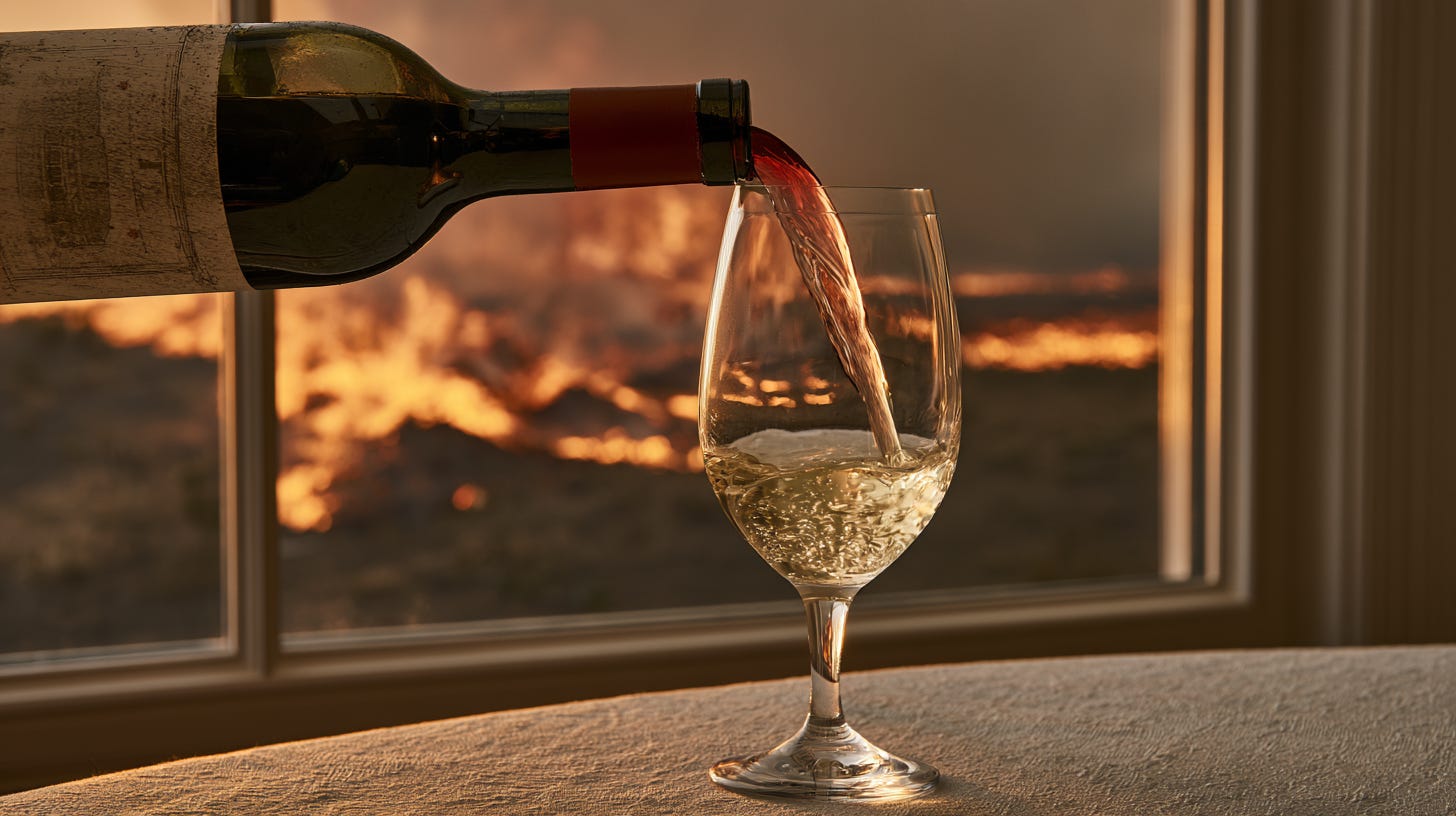
For the second time in five years, tens of thousands of hectares of Bordeaux have been burning. Close to a quarter of a million people have been evacuated and people in the heart of the city are walking around wearing masks.
As I write this on July 30th, following yet another intensely hot, 40C day when the affected area didn’t expand, like others, I’m tentatively confident that the worst is over. Here at least.
Spain is still contending with fires that are 50 percent bigger than the ones we’ve had.
As, hopefully, work starts on putting everything back to normal, winemakers are going to be praying for rain. The succession of heatwaves this year mean that instead of getting yields of 40hl/ha they’ll be picking at 25-30hl/ha even if the heavens open. And as one said to me, it’s hard to make great Bordeaux from raisins.
Unsold wine
Even if we hadn’t had this intense heat, few in the region were looking forward to autumn. There is a lot of surplus wine hanging around, even after smaller harvests. Bordeaux sold 2.98 million hectolitres in the 12 months to the end of March 2026 — down about 12% year-on-year and the first time it has fallen below three million hl in decades. To put this in context, the 2024 vintage, the region’s smallest since 1991, produced around 3.3 million. In April 2026, the government unlocked around €40 million for crisis distillation to turn unsellable wine into industrial alcohol — the same tool used in the 2023 crisis, when hundreds of millions of litres nationally were registered for distillation.
It is widely accepted that many producers are sitting on about four unsold vintages of inventory, with no revenue against the capital tied up in it. And now an unknown number of them are facing the additional threat of smoke taint, after well over a week of fierce fires, winds that carried the smoke 60 or 70 km, and vines that had recently gone through veraison and are thus at their most vulnerable.
Online experts
Inevitably, there are Instagrammers posting images of themselves with maps showing how there is ‘no way’ that grapes in this or that particular region will have been affected. The Australian and California experience reveal that it’s not that simple. The decisive question is not simply “How far is the vineyard from the fire?” It is: How much relatively fresh, wood-derived smoke actually passed through the fruiting zone, and for how long?
A vineyard 5 km from a fire but outside the plume may escape; one 50 km downwind can be affected. The most useful Australian study followed Victoria’s 2019 Bunyip bushfire:
Significant smoke compounds were measured at Gladysdale, 11 km, and Hoddles Creek, 15 km respectively from the blaze while Gembrook, only 4 km away, recorded the lowest exposure because it was not directly downwind.
Researchers concluded that smoke-taint compounds in the air and grapes generally declined with distance—but wind direction could overwhelm the distance effect.
Australia’s AWRI guidance states that although fresh smoke generally presents the greatest risk, smoke that has drifted hundreds of kilometres has caused smoke taint. That should not be interpreted as meaning every distant haze is dangerous—only that distance cannot, by itself, exclude the possibility.
Great white hope
One possible - partial - solution to the problems of excess wine and possible smoke taint will be to turn black grapes into white wine, as Sylvie Cazes notably did last year with Folie de Chauvin, along with a short list of other châteaux including Cap de Mourlin, Meyney, la Dauphine and Virginie Thunevin.
Having a speedily marketable Blanc de Noirs, even if it can only be sold as Vin de France, was already an appealing prospect, but the threat of taint makes it even more so, as Sally Evans of Chateau George 7, noted in a LinkedIn post,
“The possible risk may encourage even more of us to make some Blanc de Noir this year given it is the skin contact which is the most problematic.... already in the plan for this year but maybe we should make more than had planned!”
In 2020, 165,000–325,000 tons of California wine grapes were left unharvested because of actual or suspected smoke exposure.
The logic behind this move is clear: the volatile phenols — guaiacol, 4-methylguaiacol, the cresols, syringol and related compounds responsible for smoke taint - land on the grape skins. The vine then converts many of them into odourless sugar-bound ‘glycosides’ which, with the phenols, concentrate in the skins rather than the pulp or juice.
In 2020, 165,000–325,000 tons of California wine grapes were left unharvested because of actual or suspected smoke exposure.
Cut the skin contact
Get rid of the skins and you cut the risk. As UC Davis states plainly: “Due to the presence of volatile phenols in the skins, white wines are less impacted.” Oregon State’s extension guidance similarly says “limiting skin contact — such as in the production of rosé or white wines — can lower the concentration of smoke aroma compounds,” and explicitly recommends making a rosé from smoke-exposed red grapes rather than a red wine.
As the Australian Wine Research Institute notes, “volatile phenols and their glycosides extract very quickly from the grape skins,” so simply shortening maceration or fermenting cooler “does not really make much difference if you are not going to make a Rosé wine.”
In other words, the greatest benefit should theoretically come from making a genuine white (immediate whole-cluster pressing, “blanc de noirs”). Oregon State reinforces this: “Pressing red wines early is not an effective way to reduce the concentration of smoke compounds; these compounds are extracted into the wine early to mid-fermentation.”
To get the maximum benefit, producers are advised to go for whole-cluster pressing, minimising berry crushing/damage at harvest, keeping fruit cool, using free-run juice, and keeping press fractions separate. Later press fractions unsurprisingly carry markedly higher phenol concentrations because they squeeze more from the skin.
Hopefully, for estates capable of commercialising white (or pink) wine, this strategy may mitigate the potential disaster of 2026. But, as UC Davis notes, rosé in particular “may not be an economically viable option…” for low to medium smoke impacted grapes” because it involves turning premium red fruit into a cheaper category.
And, the California institution continues, “the aroma profiles of white wine can still be impacted even though the wines do not showcase the traditional sensory markers for smoke taint”. The glycosides can hydrolyze later, and retronasal/ashy characters can appear even when the classic smoky markers don’t.
Testing, testing
Whatever style they are planning to produce, winemakers are going to want to know whether their grapes have been affected. Fortunately, testing for smoke exposure is fairly simple, but not as simple as sniffing the fruit. Smoke-exposed berries may smell perfectly normal because of those volatile, odourless glycosides that can pass unnoticed before breaking down during fermentation and releasing smoky, medicinal or ashy flavours.
So, the Australian Wine Research Institute recommends taking one bunch from each of 30 randomly distributed vines, mixing berries from the bunches and sending approximately 500g to a laboratory that is equipped for GC–MS and LC–MS analysis.
A more reliable way of testing is to combine the laboratory analysis with a micro-fermentation. Oregon State recommends at least 40–50 bunches and roughly 4.5kg of fruit, fermented on skins under controlled conditions and carefully blind-tasted, and analysed for free and bound smoke markers.
The obvious drawback of this last option is that it cannot provide an immediate answer on the morning a vineyard is due to be picked. The only way it could work is if there are any early-ripening grapes close enough to the main vineyard for this to be practicable.
We’ve had hot years and wildfires before, and California and Australia have become used to them in recent years. In 50 years of watching the industry, I’ve personally never seen anything like this in a region like Bordeaux.
Hope and prayers
I'll be writing more about the fires and their consequences for paid subscribers next week. But first, a word about why I write this.
The wine industry’s response to this situation will be what it always is: sympathy for the growers, concern about the vintage, a press release about resilience. And then everybody will go back to pretending that what’s happening is a series of unfortunate weather events. Which for a deluded few, as I’ve discovered in online exchanges this week, are not related to man-made climate change.
That change is real, and it’s not going to improve. But, as those producers with four years’ stock know, it’s not the only challenge the industry is facing.
I started Wine Thinking a year ago following the closure of Meininger’s International, because I couldn’t find the kind of platform for open and informed discussion about the wine industry that I was looking for.
There are plenty of wine publications. Most of them fall into three categories. The first tells you what to drink — scores, tasting notes, recommendations, the same bottles everyone else is recommending. The second tells you how wonderful everything is — harvest stories, family estates, the romance of terroir. The third, often hard to distinguish from the second, is advertorial for regions and brands. All three have their place.
None tells you what’s actually happening to the industry.
No blip
What’s happening is that wine as a business is not going through a blip that will disappear when Gen Z starts drinking more and/or we come up with a way to counter the WHO. It is in structural decline, and has been for decades, and almost nobody involved in it wants to say so publicly.
I’ve been working in wine since the 1970s and writing about it professionally since 1981. I’ve launched brands, sold wine in over 70 countries, worn out shoe leather visiting distributor and retailer offices and US liquor stores.
Over the years, I have watched the market shift under my feet more times than I can count. When I started out, as editor of the magazine that would become WINE International, I had to commission an article explaining to UK readers what a varietal wine was. And what I see today is different from anything I’ve seen before. Not a downturn. Not a cycle. A structural break.
Since 1961, the world’s population grew from 3 billion to 8 billion. Cheese consumption grew fivefold. Coffee fivefold. Beer and spirits doubled. Wine consumption went down. Per capita, it’s falling off a cliff. Half of the adult population of France used to drink wine every day; today, it’s just one in nine and 69% rarely or never drink it at all And now 15–25% of the world’s vineyards are scheduled to be pulled up.
That’s not a story about bad weather or a few difficult vintages. It’s a story about a product losing relevance.
There is an array of forces driving this, and they’re all hitting at once: climate change, health and cancer warnings, GLP-1 drugs like Ozempic, a shift away from alcohol across several age cohorts, concern about the effect of alcohol on sleep patterns, demographics, and a wave of alternative beverages. I’ve built a projection model that takes all of these into account. Under the base-case scenario, wine consumption falls 27% by 2050. Beer falls 11%. Spirits fall 7%. NoLo grows 167%.
I’m not guessing. Every number in that model is sourced — OIV, IWSR, WHO, UN population data, peer-reviewed climate research. You can play with the interactive version yourself here.
So why does this matter to you?
If you’re in the wine industry — a producer, a distributor, a retailer, an investor, a marketer — you need to understand these forces because they’re going to reshape your business. Not in 2050, which in any case, sounds further away than it is, but now. The vineyards being pulled up this year won’t produce wine next year. The consumers who started on Ozempic last month aren’t coming back to your restaurant’s wine list. Or at least not nearly as often. The people who’ve given up drinking alcohol during the week to improve their sleep patterns aren’t simply going to return to a daily dose of wine because we think they ought to.
If you’re a wine drinker — someone who cares about what’s in your glass — you need to understand all of thyose people because the wine you love is going to get more expensive, harder to find, and culturally marginalised. The question isn’t whether wine survives. It’s what kind of wine survives, and who gets to drink it.
This is what I write about every week
The free posts give you the diagnosis — the data, the arguments, the contrarian takes that you won’t find in the trade press because the trade press depends on not offending its advertisers.
The paid posts give you the prescription — the deep dives, the company analysis, the strategic frameworks for navigating the crisis. Who’s adapting. Who’s dying. What works. What doesn’t.
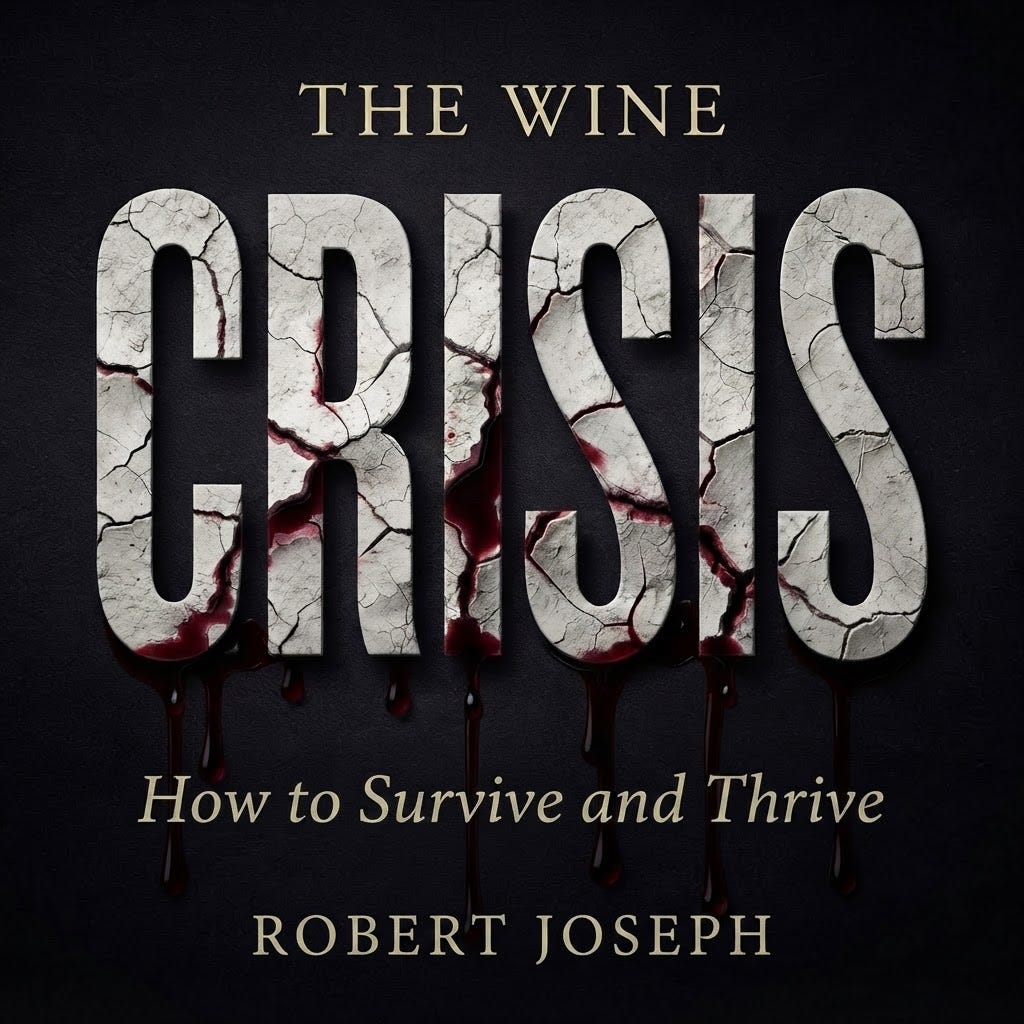
I profile over 30 companies in my upcoming book, The Wine CRISIS, including my own. I give them all the same space and the same honest assessment. That’s the approach I bring here too. I’m not here to be liked. I’m here to be useful.
What you get as a paid subscriber
A free ebook edition of The Wine CRISIS when it is launched this October, if you take an annual subscriptio
- One in-depth analysis piece every week — typically 2,000–4,000 words, with data, charts, and sourcing
- Access to the full archive — every paid piece I’ve written, going back over a year
- The ability to comment and join the conversation — the paid community is where the most interesting discussions happen
- First access to new research and data from the 2050 model as it develops
What it costs:
$8/month, or $80/year. The annual option gives you two months free and the ebook — which will retail at £9.99. So you’re getting the book plus a year of analysis for less than the price of three bottles of wine that, statistically speaking, you’ll probably enjoy less than you expect.
Why I charge:
Because the research, the analysis and the writing all takes time. Because the model took a lot of work to build. Because I interview people who won’t talk to free publications. Because the trade press won’t write this, and the academic press can’t, and someone needs to.
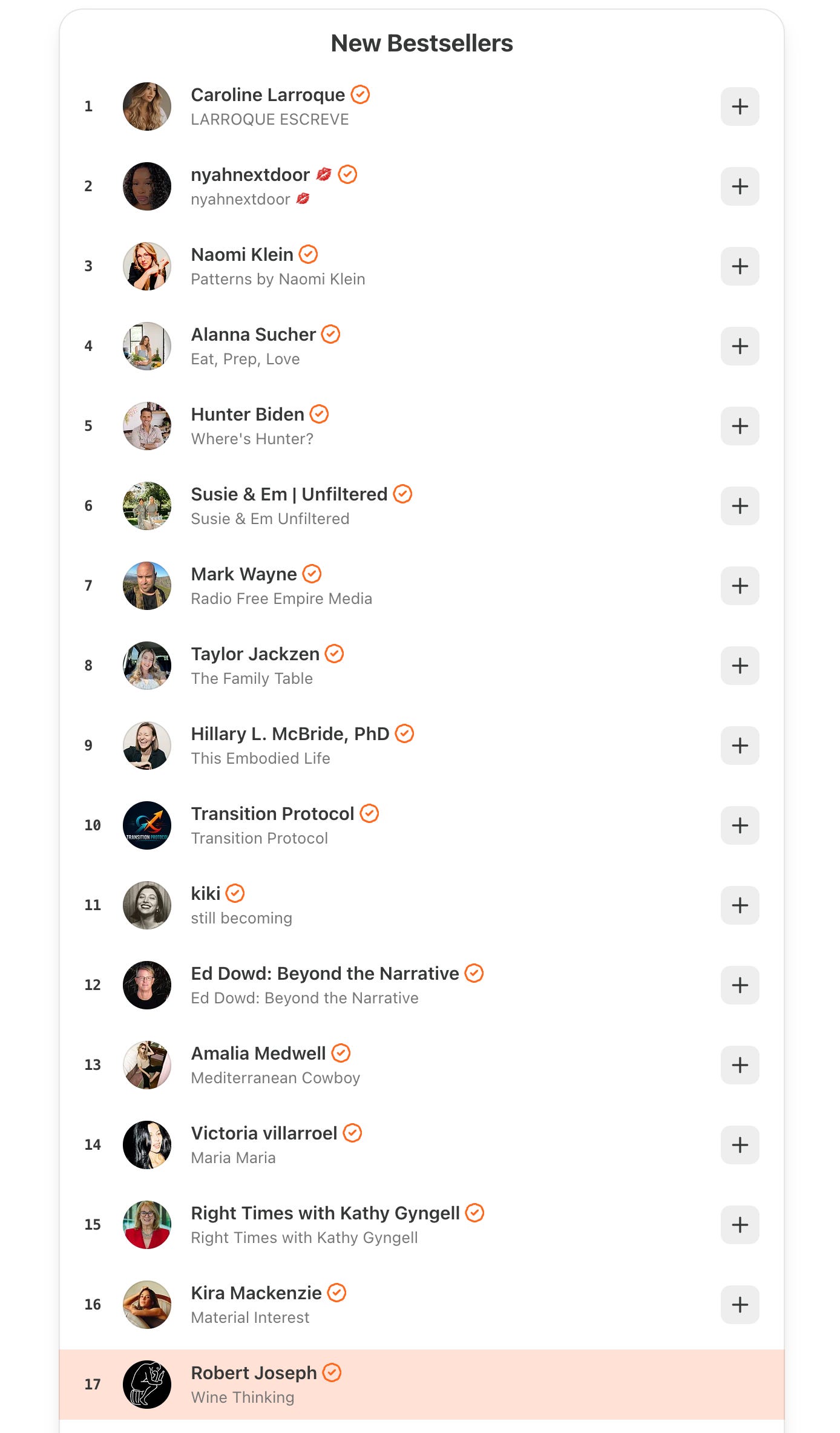
The Substack has, extraordinarily been ranked at number 17* on the platform’s ranking of ‘New Bestsellers’ that includes Naomi Klein, Hunter Biden (!) and Ed Dowd. I have 3,650* subscribers - not bad in a year, and 121* of them now pay. I’d like that number to be higher, not because I need the money, but because the conversation gets better when the room is full of people who care enough to invest in it.
If you’ve been reading for free and finding it valuable, this is the moment. The book is coming. The model is live. The next year of analysis is going to matter more than the last. I’d like you to be part of it.
* Numbers updated PM on 31/07/26
Subscribe here
Robert
Robert --Helluva screed!I am not sure where mine stands in your triad of publication types, but your analyses is always worth the attention. One thing you left out (sort of, obliquely?) of reasons for wine decline is price escalation-- bang for the buck which is ( I think) for younger people, especially, (remember us at 25?) a big reason why wine will have a difficult time regaining market share. If everything made is geared to $15-20 (more usually, now) wines, well, no wonder people will stop buying wine. I find it ridiculous, alternate reality that so many wine writers, retailers etc continue to say that $35+ wines are "everyday wines"! Maybe if you are a millionaire, which seems to be the future market for wines if things continue to develop as the industry seems to believe that premiumization is the future.
And Bordeaux? Unless these necessary{! } White wines come out below $20 (not gonna happen!) it is doubtful that things will change much. As a subscriber, I look forward to the book, by the way. Carry on! Joel
By the way, how are your Georgian wines doing? I remember tasting one of them with you, in ...Wiesbaden, three years ago?
Jb